
When Even Conquerors Learn They Can’t Erase the World
What Alexander, Rome, the Mongols—and Our Own Culture Wars—Tell Us About How We’re Meant to Live Together

Picture a city burning.
Statues toppled. Temples cracked open like eggs. A people’s entire way of speaking to the divine shattered into rubble at the feet of an army that just arrived from somewhere else. The image is familiar because it has happened so many times across human history that it has almost become part of our background noise. Conquerors conquer. Cultures get crushed. That is the story we tell ourselves.
Now picture something else. The same conqueror, days or weeks later, making an offering at a local shrine. Wrapping himself in the robes of a foreign priesthood. Walking into someone else’s sacred story and finding a place to sit down inside it. This image is less familiar. It is also far more interesting, because it is far more common than we tend to admit.
If even the most ruthless expanding powers in history eventually realized they could not simply erase other people’s gods, stories, and identities—what does that tell us about how cultures are actually meant to coexist and grow?
That is the question this piece wants to sit with. Not a polite question. Not an academic one. A real question with teeth, because it reaches from ancient campaigns all the way into our present moment of book bans, targeted persecution, and the deliberate erasure of histories that certain powerful people find deeply inconvenient. Before we go further, one thing needs to be said clearly: this is not a rehabilitation project. Alexander the Great, Rome, the Mongols—none of these are heroes we are rescuing from history’s unfair judgment. They were brutal, often spectacularly so, and their power was built on suffering that deserves to be named and remembered. But that is precisely what makes the realization they stumbled into so remarkable. It didn’t emerge from philosophers meditating in quiet rooms. It came from people holding swords. And even they had to put the swords down in front of the problem of culture.
Get Complete Access
A substantial portion of the content available here is complimentary, while a significant amount is exclusively accessible to those who contribute to the support of this publication. Paid subscribers receive the following benefits:
• At least 24 exclusive articles per year (2 long-form pieces per month) that is the minimum that you will receive. The actual number will probably be closer to 3 to 4 per month (36-48 per year.
• Full archive access to every piece I’ve ever published
• Topic request privileges: Suggest specific historical events or figures you’d like me to cover
[Join as a paid supporter - $10/month or $100/year or $200/year as an Engaged Supporter/Founding Member]
Alexander: Becoming Part of Other People’s Sacred Stories
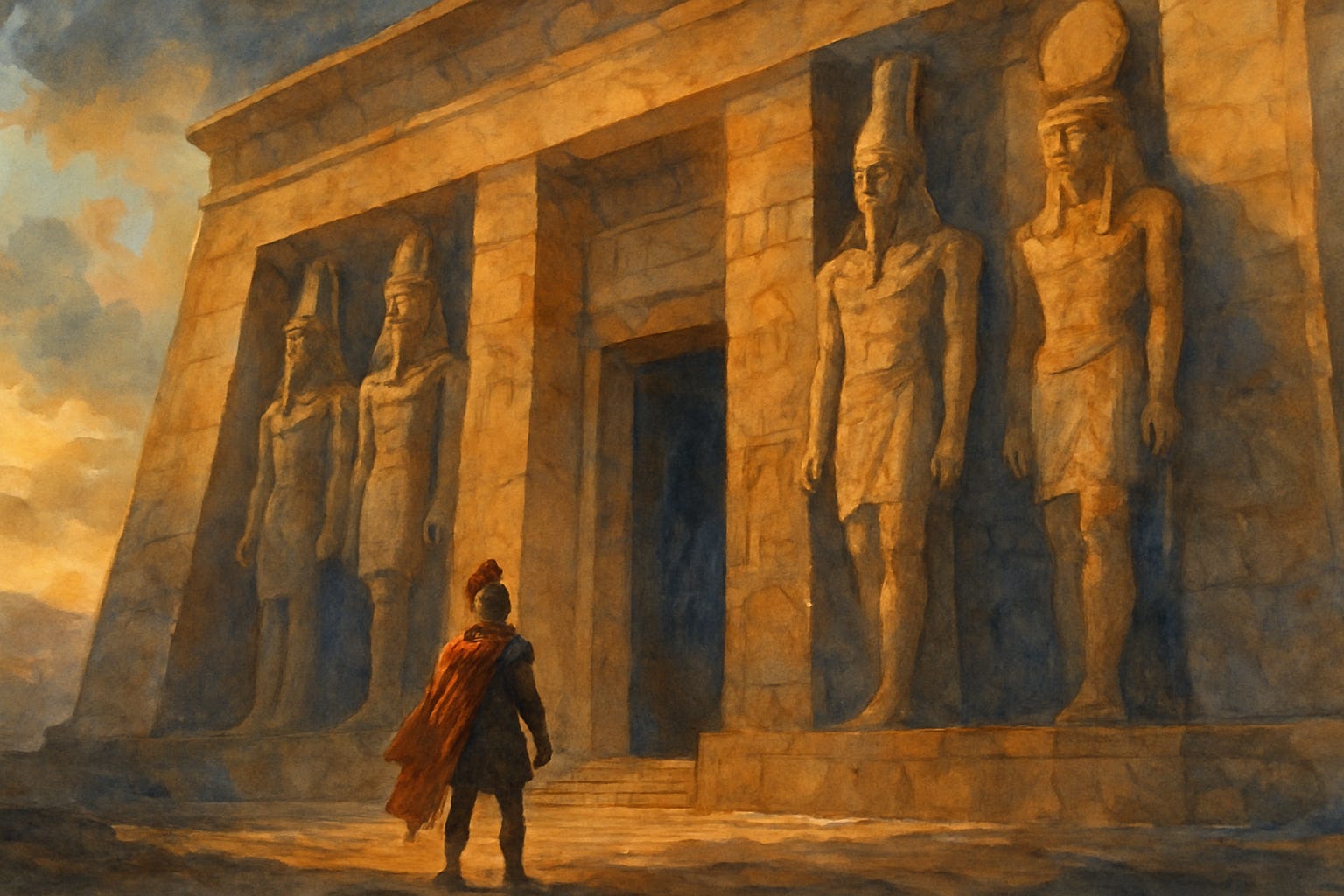
In 331 BCE, Alexander the Great made a detour that made no military sense. In the middle of one of the most audacious campaigns the ancient world had ever seen, he marched his army into the Libyan desert toward a remote oasis called Siwa. He was not chasing an enemy. He was going to consult an oracle—specifically, the oracle of the god Ammon, whom the Greeks had already begun to identify with their own Zeus, producing a hybrid deity they called Zeus-Ammon.
He made the journey. He entered the oracle’s inner sanctum alone. He emerged, according to every account we have, convinced that he was the recognized son of Ammon—which in Egyptian religious logic made him something more than a foreign occupier. It made him Pharaoh. It made him divine. It wove him into Egypt’s sacred story rather than leaving him standing outside it as a conqueror with a spear.
This was a choice.
He could have simply held Egypt as conquered territory managed by Macedonian administrators. Instead, he stepped into the role Egypt’s religious tradition already had waiting. He didn’t ask Egypt to become Macedonian. He became, at least symbolically and ritually, Egyptian. Throughout his campaigns, he offered sacrifices to local deities alongside his own gods, honoring each culture’s divine framework on its own terms. In Persia, he adopted Iranian royal dress, court ceremonial, and Achaemenid administrative practices—not as a costume, but as a deliberate claim to legitimate rulership within a Persian framework. He arranged mass intermarriages between his officers and Persian nobility at Susa, creating generational bonds between cultures that no battle order could manufacture.
His own Macedonian generals hated it. They saw their commander dressing like the enemy, bowing to foreign gods, blurring the lines that were supposed to separate the victors from the defeated. Their outrage is, if anything, the most convincing evidence that what Alexander was doing was real and not theatrical. He wasn’t performing tolerance. He was restructuring identity—his own and everyone else’s—around something larger than any single culture’s claim to be the only valid one.
What grew in the world he left behind was the Hellenistic civilization: not Greek culture stamped over a blank surface, but a genuine hybridization of Greek, Persian, Egyptian, Babylonian, and dozens of other traditions into something that was recognizably all of them and completely none of them. Cities like Alexandria became the living proof of what this looked like—libraries where different intellectual and spiritual traditions cross-pollinated, temples where gods from different pantheons stood comfortably in the same sacred space, public life conducted in a Greek that had absorbed the vocabularies of every culture it touched.
What did Alexander see in front of him that made him decide it was better to become part of other people’s sacred stories than to erase them?
***
Rome: Syncretic Instinct and Its Hard Limits
Rome was less poetic about it and more systematic. As the Republic and then the Empire spread across the Mediterranean world, they encountered an almost incomprehensible variety of gods, cults, rituals, and religious traditions—and their instinctive response was not suppression. It was absorption.
The Romans had a habit of looking at foreign deities and finding their own gods inside them. Greek Zeus became Roman Jupiter. Greek Ares became Mars. Aphrodite became Venus. When they moved into new territories the logic extended further—a Celtic goddess of healing springs in Britain merged with the Roman Minerva and became Sulis Minerva, a deity that both Romans stationed there and local Britons could recognize as theirs. The Egyptian goddess Isis swept through the empire and became one of the most beloved figures in Roman religious life, offering a kind of divine maternal tenderness the Roman pantheon hadn’t quite provided. The Persian Mithras found devoted soldiers’ shrines from Britain to Syria.
This wasn’t accidental generosity. The Romans largely viewed foreign gods as different names for the same fundamental divine realities. To honor Jupiter was not, in this theological view, so very different from honoring Zeus or Amun—they were expressions of the same sky-father principle in different local idioms. Subject peoples were largely free to worship their own gods, attend their own rituals, and maintain their own religious traditions, provided they also participated in the civic-religious practices that held the imperial community together. The deal was essentially this: your gods are welcome in our world, and we ask only that you acknowledge ours in return.
For most people, in most places, most of the time, this worked.
Then came the limits. What Rome could not absorb was refusal—a community that insisted its god was not just different but exclusively and completely true, that participation in Roman civic religion was an act of idolatry, that the empire itself was, in some spiritual sense, illegitimate. Judaism presented this problem. Christianity presented it differently. Both insisted on a kind of monotheistic exclusivity that made the Roman religious commons feel like a threat rather than an invitation.
The result was centuries of oscillation between tolerance and brutality. Judaism was technically a recognized religion under Roman law—and yet political resistance combined with theological incompatibility escalated until 70 CE, when Rome besieged Jerusalem, destroyed the Second Temple, and scattered a people across the ancient world in a catastrophe whose consequences reached far beyond anything Rome had calculated. Early Christians faced periodic persecution, not primarily for their beliefs, but for the refusal to perform the civic-religious acts that Romans understood as the cement of a shared social world.
Rome gives us the clearest portrait of this dynamic’s contradiction. An empire that could welcome Isis, Mithras, Cybele, and a hundred minor deities from a dozen conquered nations could not ultimately tolerate the groups that refused to be welcomed in return. Its syncretic capacity was genuine. But it contained a hard edge. Incorporate, or eventually face the consequences of our patience running out.
How does an empire that can crucify thousands still choose, most of the time, to add foreign gods to its list rather than eliminate them—and what does that contradiction say about the real limits of force?
***
The Mongols: Religious Freedom in a Sea of Violence
No empire in recorded history killed on the scale the Mongols did during their thirteenth-century expansion across Eurasia. Cities were destroyed with a thoroughness that defies easy description. Populations were wiped out or driven into displacement by the millions. By every measure, the Mongol empire was among the most violent political entities ever assembled by human hands.
Which is exactly why what Genghis Khan did with religion is so staggering.
At a time when virtually every other major power was promoting its own religious tradition as the correct one—and using that claim to justify whatever it needed to do to whoever stood in its way—Genghis Khan established something close to complete religious freedom as formal state policy. Buddhist monks, Christian clergy, Taoist priests, Muslim imams—all were exempted from taxation and from public service obligations across the Mongol empire. The Mongol court hosted formal religious debates among scholars of different traditions, not to find a winner, but out of what appears to have been genuine curiosity about how different people approached the same deep questions about what is sacred and why.
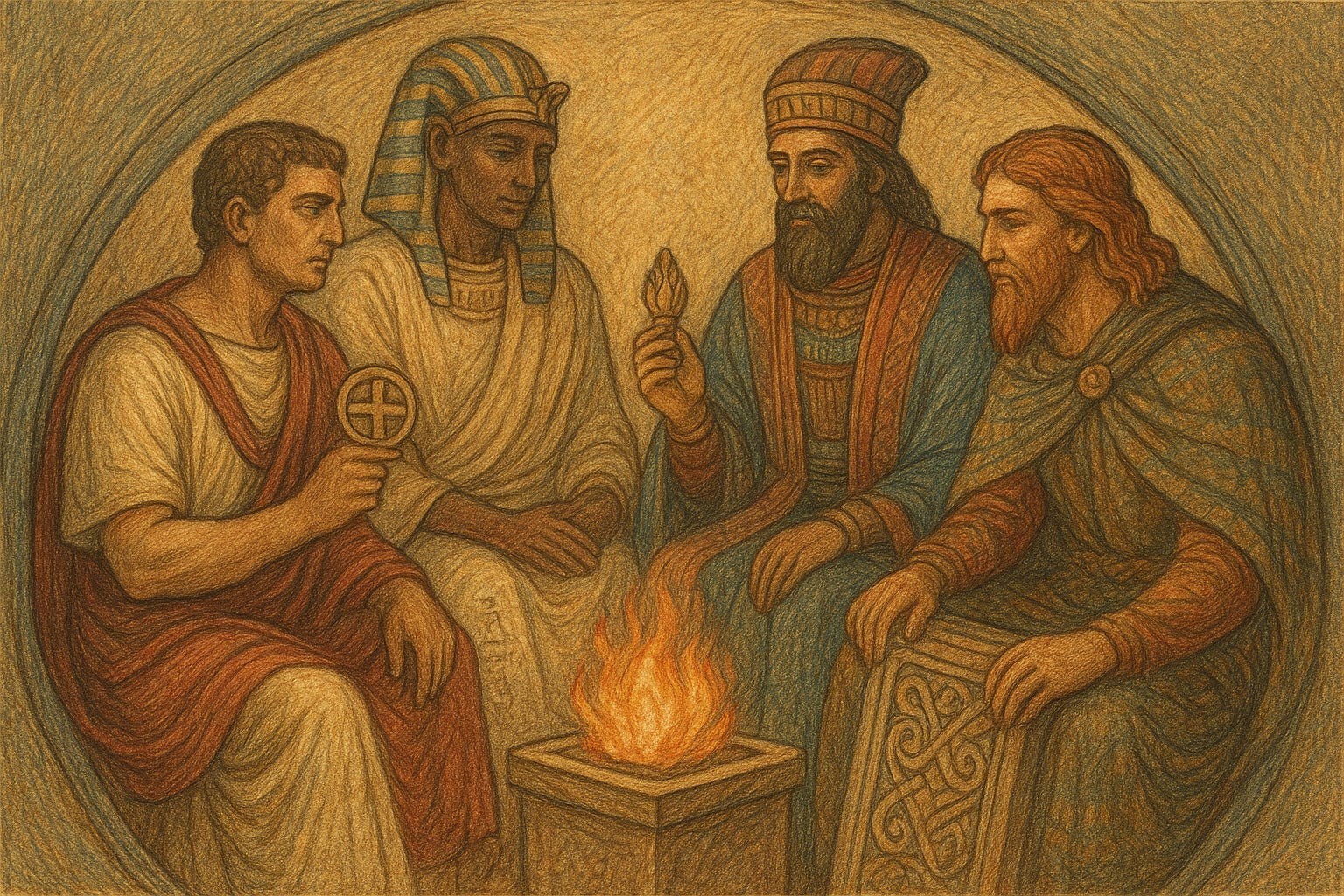
Marco Polo recorded Kublai Khan’s own stated philosophy on the matter: that he honored all four of the great prophets—Jesus Christ, Mohammed, Moses, and the Buddha—because he could not be certain which was greatest in heaven, and therefore saw wisdom in honoring them all. Whether this represents personal conviction or supreme imperial diplomacy—and it was almost certainly both—it describes a man who looked out at the world’s competing claims to divine truth and concluded that honoring multiple paths was wiser than insisting his alone was valid.
The strategic logic is not hard to identify. The Mongol empire was so vast, so culturally diverse, so impossible to govern through any single cultural or religious framework, that attempting to impose uniformity would have generated constant, exhausting rebellion. They had already learned, on campaigns that spanned continents, that you could take a city in a matter of days. You could not take a people’s spiritual life in any amount of time. The tax exemptions for religious leaders were not acts of piety. They were investments in stability—ways of ensuring that the people who held enormous social authority across the empire had material reasons to cooperate rather than resist.
But here is the thing: whatever the motive, the effect was a world in which multiple faith traditions coexisted and in some cases flourished under Mongol rule. The pragmatic calculation produced something that looked, from the outside, remarkably like genuine pluralism.
Why would a power that feared nothing on the battlefield go out of its way not to interfere with priests and monks—unless it had learned, the hard way, that spiritual life doesn’t respond to the sword the way cities do?
***
What All Three Keep Teaching Us
Three empires. Separated by centuries. Operating under radically different cultural assumptions, in different parts of the world, with different gods and languages and strategies. And all three keep arriving at the same place.
You cannot simply erase other people’s gods and stories and expect what remains to function.
Alexander found that the only way to rule a world of many peoples was to enter their worlds rather than demand they enter his exclusively. Rome found that absorbing foreign religious life into a shared framework was dramatically more effective than suppressing it—and that suppression, when it came, generated exactly the resistance and instability it was meant to prevent. The Mongols found that exempting spiritual life from imperial interference was the fastest path to governing an empire of staggering diversity without drowning in rebellion.
The ethical line must be drawn here, clearly and without apology. The methods were not noble. Every one of these empires was built on coercion, dispossession, and mass death. None of their cultural integrations prevented them from committing atrocities when they chose to. None of this is the model. What is worth salvaging—the only thing—is the realization they kept bumping into despite themselves: at a certain scale, at a certain density of human diversity, erasure simply does not hold. The world keeps reasserting itself. The gods come back. The stories survive underground and re-emerge. The people who were supposed to disappear refuse to.
If overlapping worlds are the only way even empires survive, what does that imply for cultures like ours that claim to have moved beyond rule by the sword?
***
From Empire to Federation: The Same Syntax, Different Words
Here is a useful way to think about what those conquerors were actually encountering.
Every culture, religion, and ideology operates through what might be called a syntax—a particular vocabulary of symbols, stories, rituals, and doctrines that carries a community’s deepest commitments forward through time. These syntaxes vary enormously. The specific names of the gods. The particular gestures of prayer. The exact formulation of justice, mercy, or the sacred. The metaphors a culture reaches for when it tries to describe what it means to be human. People will fight to preserve their syntax, because the syntax is not decoration. It is the living vehicle of something more fundamental—shared human content that appears across cultures with remarkable consistency: the need for justice, dignity, safety, belonging, and some relationship with whatever is larger than the self.
Zeus and Amun were different syntaxes pointing at the same sky. The Greeks and Egyptians knew this well enough to name the result: Zeus-Ammon. A hybrid deity that let both communities hold their own vocabulary while recognizing that they were, at some deeper level, speaking toward the same thing. What the Mongols practiced by hosting theological debates among scholars of different faiths was a rougher version of the same recognition: we may not agree on the name, but we seem to be arguing about the same questions.
This is not a new idea dressed up in ancient clothing. The United Federation of Planets in Star Trek—a fictional construct, yes, but one that Gene Roddenberry built as a deliberate philosophical argument about human potential—runs on exactly this logic. The Federation is a union of radically different civilizations, each with its own social structures, each semi-autonomous, all bound together not by cultural conformity but by shared principles: liberty, equality, justice, cooperation, the universal rights of sentient life. And underneath all of it, the Vulcan philosophical ideal that Roddenberry called IDIC: Infinite Diversity in Infinite Combinations. The belief that beauty, growth, and progress result not from uniformity but from the meeting of unlike things.
That is the vision. Now look at where we actually are.
In 2025, more than 850 bills targeting LGBTQ+ people were introduced in U.S. state legislatures—a record. Many of them were aimed specifically at making transgender people legally invisible: removing healthcare access, erasing recognition, pushing queer and trans lives out of public space and into silence. This is not policy disagreement. It is erasure with a legal signature. At the same time, more than 4,000 books were targeted for removal from school libraries in a single recent year, nearly half of them centering the experiences of LGBTQ+ people and people of color. Curriculum fights stripped discussions of slavery, Jim Crow, and systemic racism from classrooms across multiple states—the explicit goal being that students would encounter a version of American history scrubbed clean of its most instructive and painful chapters.
These are not isolated events. They are a pattern. And the pattern has a name: erasure. Not with legions, not with siege engines, but with school boards and platform policies and legislative sessions and the digital mob’s capacity to pursue permanent social death. We have simply modernized the tools. The impulse is ancient. If we can make this person, this community, this chapter of history disappear—we will not have to reckon with what they represent.
History has already answered whether this strategy works. What is driven underground does not vanish. It mutates. It festers. It comes back in forms that are harder to recognize and harder to reason with. Rome suppressed Jewish political and religious life across decades of escalating conflict and produced not a quieter province but one of the most combustible episodes in the ancient world. Attempts to erase racial history from American classrooms do not make the legacy of slavery or the patterns it generated disappear. They simply strip students of the intellectual tools they might need to recognize those patterns when they re-emerge—and they always re-emerge.
Some of the people pursuing these erasures know this. They are not confused about what history teaches. They simply don’t have a problem with what it taught, and they would not mind very much if certain things happened again.
If our history keeps proving that people will not let their identities and memories be wiped clean, what would it look like to build a world that assumed that from the start—and designed for coexistence, honesty, and mutual protection instead of deletion?
***
Are We Ready to Stop Trying?
We like to think we have outgrown the old empires. And in some ways, we have. The specific violence of conquest—armies crossing borders to install kings and gods by force—is no longer the primary mechanism. What has replaced it is in some ways more insidious precisely because it moves in the language of law, education, and democratic process. The school board that decides which histories are too dangerous to teach. The legislature that decides which identities are legally permissible. The algorithm that decides whose voice gets amplified and whose gets buried. The social pile-on that decides, in the space of a few hours, that a person’s entire existence is forfeit and their decades of work are to be treated as if they never happened.
We have swapped the sword for the curriculum standard, the platform policy, and the pitchfork of digital outrage. The impulse is the same.
The empires we looked at in this piece had no moral clarity about what they were doing. They did not refuse total erasure out of principled commitment to human dignity. They refused it because they ran into its limits—because the scale of their ambition exceeded what force alone could manage, and because the only way to hold together a world of many peoples was to give those peoples enough room to remain themselves inside a larger shared structure. The tragedy is that they kept the annihilation option in reserve, and reached for it whenever patience ran out. They saw something like a federated future and kept sliding back into empire.
The question is whether we can make the same discovery without requiring catastrophe to force it on us. Whether we can arrive, deliberately rather than reluctantly, at the understanding that diverse syntaxes are not a problem to be solved but a reality to be honored. Not by dissolving all differences into a comfortable uniformity that serves nobody, but by building—consciously, stubbornly, with full awareness of how hard it is—the institutions and habits of mind that let different communities, different faiths, different sexual and gender identities, different racial and cultural memories coexist and argue and grow inside a shared commitment to human dignity.
What would it look like to become the kind of society that refuses to forget slavery, conquest, bigotry, and the slow grinding violence inflicted on queer and trans people—not to drown in guilt, but so we cannot be talked into cheering for those things again?
What if the real measure of a mature culture isn’t how thoroughly it defeats its opponents, but how many truths and how many kinds of people it can hold without reaching for the delete key?
If even our empires couldn’t erase the world—are we finally ready to stop trying, and start learning how to live with the whole of what we have been?