
Echoes of Empire: Part II
The Punic Wars: A Cautionary Tale for the U.S.-China Economic and Trade War

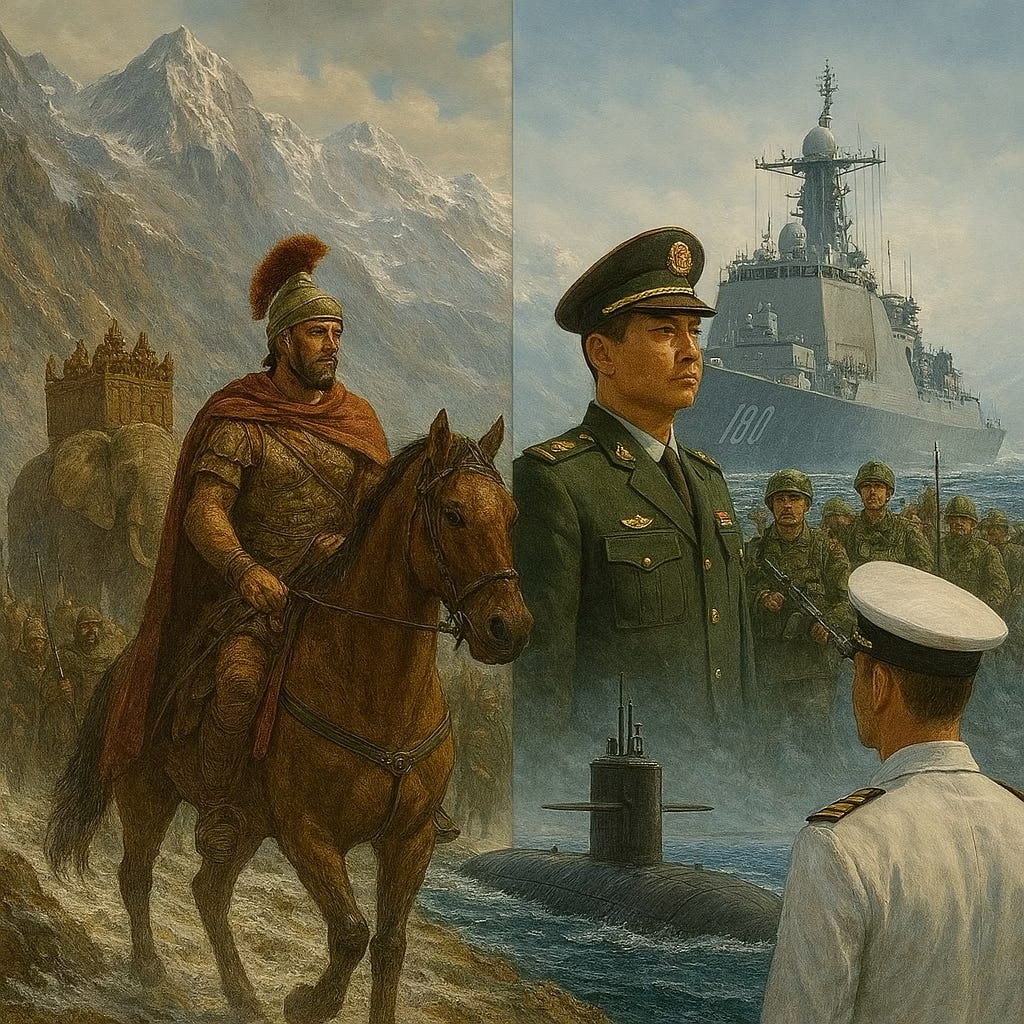
When Elephants Fight – Military Innovation and Alliance Warfare
The sun climbed over the Apulian plains on August 2, 216 BCE, casting long, golden shadows across the battlefield at Cannae. Hannibal Barca, Carthage’s master strategist, watched as the largest Roman army ever assembled—80,000 soldiers in gleaming formations—stretched almost a mile wide. In front of them, his own 50,000 Carthaginians, Gauls, and Spaniards waited in a formation that looked deceptively fragile. What followed became the most famous tactical maneuver in military history: a battle that would be dissected in war colleges for millennia, a demonstration of genius that nonetheless revealed a timeless truth—tactical brilliance alone cannot secure strategic victory.
Hannibal’s double envelopment at Cannae remains a masterpiece of maneuver warfare. The Roman legions, confident in their overwhelming numbers, surged forward into what they thought was a collapsing Carthaginian line. In reality, Hannibal had set a carefully baited trap. As his center retreated slowly, his elite African infantry on the flanks pivoted inward, his cavalry swept around, and the Roman army found itself surrounded on all sides. By evening, nearly 70,000 Romans were dead or captured. Hannibal had achieved the perfect battlefield victory.
And yet, that perfection could not overcome Rome’s deeper advantages: a resilient alliance system, an unmatched logistical machine, and the political will to absorb even catastrophic losses. Rome would rise again, rebuild, and ultimately crush Carthage. The paradox of Cannae—tactical triumph paired with strategic failure—offers a lesson as relevant today as it was over two thousand years ago: technology and innovation win battles, but alliances, institutions, and endurance win wars.
---
The Innovation Arms Race
The Punic Wars were as much a contest of technological adaptation as of armies and generals. Rome’s invention of the corvus, a rotating boarding bridge, revolutionized naval warfare. By transforming sea battles into land-style fights, it neutralized Carthage’s centuries of maritime dominance and turned Rome into a naval power almost overnight. This single innovation foreshadowed the way modern breakthroughs—like cyber tools or hypersonic missiles—can upend established advantages.
Carthage responded in kind, accelerating its own innovations. Its engineers built faster ships, experimented with new ramming techniques, and deployed war elephants to create the ancient equivalent of an asymmetric advantage—tools designed to shock and destabilize an enemy unprepared to counter them.
This echoes today’s strategic rivalries. China’s development of AI-enabled warfare, quantum communications, and hypersonic glide vehicles mirrors Carthage’s efforts to offset Roman numerical superiority with disruptive tools. America’s stealth aircraft, missile defenses, and pervasive surveillance networks parallel Rome’s corvus—innovations meant to sustain dominance against rising challengers.
History warns, however, that no single breakthrough guarantees ultimate success. Just as the Anglo-German dreadnought race consumed immense resources before World War I, today’s spiraling competition in advanced weaponry may reshape power balances without immediately deciding conflicts. Rome’s eventual victory shows that lasting success depends on institutional strength and the capacity to sustain innovation under pressure.
---
Hannibal’s Tactical Genius and Its Modern Legacy
Cannae remains the textbook example of maneuver warfare. Hannibal’s deliberate placement of his weakest Gaul and Iberian troops in the center, with his elite African infantry hidden on the flanks, seemed reckless—until the trap snapped shut. Roman legions, sensing an easy breakthrough, pressed forward into an ever-deepening pocket. Then the Carthaginian flanks folded inward, the cavalry struck from behind, and Rome’s massive army became a writhing mass of trapped men.
Modern militaries have studied and emulated this lesson for centuries. German Blitzkrieg in 1939–1941 followed Hannibal’s principles: strike quickly, penetrate deeply, and encircle rather than grind down. Soviet deep battle doctrine, emphasizing rapid breakthroughs and envelopment, carried the same DNA. Today, network-centric warfare—where drones, satellites, and precision weapons allow real-time battlefield awareness—pursues the digital-age equivalent of Cannae: surrounding an enemy psychologically and logistically as much as physically.
Yet Hannibal’s brilliance could not translate into strategic victory. Rome absorbed the loss of 15% of its military-age population, refused to negotiate, and raised new armies. The lesson reverberates today: spectacular tactical wins—whether in cyber operations, regional clashes, or high-tech skirmishes—mean little if they do not shift underlying strategic realities.
---
The Alliance Advantage
Rome’s true superweapon wasn’t a device or a formation—it was its alliance system. By binding Italian allies into a confederation that granted local autonomy while demanding military support, Rome created a web of loyalty and shared interest. Even after disasters at Trebia, Trasimene, and Cannae, most allies stayed loyal. This strategic depth allowed Rome to survive blows that would have shattered other states.
Carthage, by contrast, relied heavily on mercenaries and transactional relationships. Its forces fought for pay, not shared destiny. When money ran short during the First Punic War, Carthage’s mercenaries revolted—a stark reminder that purely economic ties often collapse under pressure.
The modern world reflects this same divide. NATO’s collective defense system resembles Rome’s confederation: it creates durable commitments that bind states with shared values and institutions. China’s Belt and Road Initiative, like Carthage’s trade empire, builds influence through economic links, but such bonds may prove fragile in crisis. Similarly, Russia’s reliance on Wagner mercenaries and opportunistic proxy forces mirrors Carthage’s vulnerability to loyalty bought rather than earned.
Sustained strategic competitions are won by alliances that endure adversity. Rome’s expansion of its network parallels NATO’s post-Cold War enlargement, which provides both strategic depth and deterrence. Like Hannibal, modern adversaries gamble that victories will fracture such alliances—but history suggests otherwise.
---
Logistics and the Power of Staying Power
In the end, Rome’s greatest advantage was its logistical machine. While Hannibal’s army lived off the land, far from friendly ports, Rome built and supplied forces from a secure base, connected by roads and fortified camps. Its ability to raise new legions and launch fresh fleets—even after devastating defeats—made ultimate victory possible.
Modern parallels are clear. America’s global military posture depends on logistics: bases, supply chains, and a worldwide alliance network. China’s A2/AD strategy—employing missiles, submarines, and cyber disruption—seeks to exploit those logistical vulnerabilities, just as Carthage sought to stretch Roman supply lines.
Wars in Ukraine and the Indo-Pacific show that industrial and supply capacity remain decisive. Rome could build 1,000 warships in a decade. Today, control over semiconductor manufacturing, energy supply chains, and long-range logistics plays the same role. Sustained conflict rewards the power that can out-produce, out-supply, and outlast its rival.
---
Technology Meets Political Will
Hannibal’s story reminds us that technological brilliance and tactical success cannot compensate for fragile political foundations. Carthage’s oligarchs prioritized trade profits and minimized long-term commitments. Rome’s republican institutions, despite their flaws, fostered a political will capable of enduring staggering losses.
Modern history echoes this lesson. The U.S. in Vietnam, the Soviets in Afghanistan, and numerous 21st-century conflicts show that technology cannot substitute for staying power and political resolve. In today’s U.S.–China rivalry, emerging technologies—AI, quantum computing, hypersonics—will matter, but victory in any prolonged competition will hinge on alliances, economic resilience, and societal will.
Taiwan may become the contemporary Italy—the proving ground where advanced technologies and political determination collide. History suggests that the side with deeper alliances, a stronger industrial base, and the ability to endure setbacks will ultimately prevail.
---
Conclusion: The Enduring Lesson of Cannae
When Hannibal finally withdrew from Italy after fourteen relentless years, the strategic balance had shifted irreversibly. Rome had endured the unendurable, adapted institutionally, and emerged stronger. Carthage, for all its brilliance and innovation, had failed to build the comprehensive capabilities required for long-term strategic success.
The message for modern strategists is clear: battlefield brilliance is fleeting, but institutional endurance compounds over time. Innovation matters, but only when paired with alliances, industrial strength, and the political will to sustain protracted competition. Cannae’s echo resounds today: genius may win battles, but alliances and endurance win wars.
List of Sources & References
• Wikipedia. ‘First Punic War.’ Accessed 2025.
• History Extra. ‘The overshadowed ancient empire that rivaled Rome with maritime power.’ October 2025.
• Wikipedia. ‘Punic Wars.’ Accessed 2025.
• Britannica. ‘Punic Wars | Summary, Causes, Battles, & Maps.’ 2017.
• National Defense University Press. ‘Polybian Warfare: The First Punic War as a Case Study in Strategic Competition.’ January 2025.
• LSE Economics & Engineering. ‘The national security overflow trap: Analyzing the causes of ‘security overflow’ in the U.S.-China strategic competition.’ August 2025.
• IOSR Journal of Business and Management. ‘U.S.-China Trade War: Analysis Of The Semiconductor Industry.’ September 2024.
• AEMPS Proceedings. ‘Analysis of the Inevitability of the US-China Trade War Based on the Differences in the Economic Development Models of China and the US.’ June 2024.
• World History Encyclopedia. ‘The Anglo-German Arms Race: Riding the Waves to WWI.’ October 2025.
• Frankfurt School SGC Working Paper. ‘China vs the United States: A Game-Theoretic Analysis of the Thucydides Trap.’ December 2024.
• MSAAG. ‘The Anglo-German Naval Arms Race, 1906-1916.’ 2014.
• Peking University CISS. ‘Can the United States and China Escape the Thucydides Trap?’ 2021.
• Exeter Cathedral. ‘Review: When Rising Power Threatens Ruling Power.’ July 2020.
• Imperial War Museums. ‘Naval Race Between Britain & Germany Before World War 1.’ February 2024.
• Wikipedia. ‘Anglo-German naval arms race.’ Accessed 2025.
• War on the Rocks. ‘The Importance of the Battle of Cannae.’ July 2025.
• The Arctic Institute. ‘NATO has always been an Arctic Alliance (Part I).’ May 2025.
• War History. ‘Logistics in Roman Warfare.’ December 2024.
• Britannica. ‘Battle of Cannae | Map, Casualties, Location, Summary, & Tactics.’ August 2025.
• Wikipedia. ‘Enlargement of NATO.’ Accessed 2025.
• Legion XXI Rapax. ‘The Logistics of the Roman Army at War (264 B.C.-A.D. 235).’ 2012.
• Military History Chronicles. ‘The Battle of Cannae: The Science of Roman Defeat.’ American Military University.
• Foreign Policy in Focus. ‘The Costs and Dangers of NATO Expansion.’ May 2013.
• Saber and Scroll. ‘The Role of Supply Problems in Hannibal’s Failed Italian Campaign.’
• Never Such Innocence. ‘Development of Land Tactics - The Punic Wars.’ December 2018.
• Imperial War Museums. ‘NATO and The Cold War.’ April 2024.
• Bryn Mawr College. ‘The Logistics of the Roman Army at War (264 BC – AD 235).’ November 1999.
• Reddit AskHistorians. ‘What were Hannibal’s battle tactics that made him such a successful general?’ February 2014.
• Atlantis Press. ‘The Marian Military Reform and Its Effects on the Roman Republic.’ 2024.
• Foreign Policy Journal. ‘The Danger of Imperial Overstretch.’ July 2014.
• Futuribles. ‘The United States and the Trump administration facing the strategic overstretch syndrome.’ June 2025.